logo
İyi bir fiyat.  çevrimiçi

Ürün ayrıntıları

Created with Pixso. Evde Created with Pixso. Ürünler Created with Pixso.
Cam Santrali
Created with Pixso. 380V Dozajlama Sistemli 200tpd Cam Toplu Tesisi

380V Dozajlama Sistemli 200tpd Cam Toplu Tesisi

Marka Adı: JEFFER
Model numarası: Özelleştirilmiş
Moq: 1 Takım
fiyat: pazarlık edilebilir
Teslimat süresi: Peşinat Alındıktan 70 Gün Sonra
Ödeme şartları: L/C,T/T
Detay Bilgisi
Menşe yeri:
Çin
Sertifika:
ISO9001,ISO14001,ISO45001
Kontrol sistemi:
PLC tabanlı otomatik kontrol
Waranty:
Bir yıl
Gerilim:
380V
Kullanım:
Hammadde toplama
Malzeme:
Özelleştirilmiş
Garanti:
Bir yıl
Ambalaj bilgileri:
Tahta Sandık, Tepsi, Çelik Çerçeve vb.
Yetenek temini:
2 ayda 1 set
Ürün Açıklaması
200tpd Mild Steel Glass Batch Plant – 380V Batching System
1. Introduction

The batching system is the heart of raw material preparation in any glass manufacturing facility. It integrates feeding, weighing, dosing, and mixing operations to produce a homogeneous batch that meets strict quality standards for melting.

JEFFER’s batching solution guarantees fully automated, round‑the‑clock delivery of precisely formulated batch to the furnace – with consistent composition and uniformity, regardless of glass type. The system operates reliably 24/7, 365 days a year, minimising human intervention and maximising productivity.

To eliminate design errors and reduce project risks, we employ 3D modelling throughout the engineering phase. This approach ensures dimensional accuracy, prevents costly on‑site rework, and shortens the overall installation schedule – directly benefiting our customers with faster commissioning.

2. Pre‑treatment of Raw Materials

Raw materials must meet specific particle‑size requirements to achieve the desired melting efficiency and final glass properties. When the incoming granularity fails to comply with process specifications, pre‑treatment (such as crushing, screening, or drying) becomes essential before batching.

Glass‑making materials are broadly classified by their role and proportion: primary ingredients form the bulk of the recipe, while secondary additives modify physical or chemical characteristics. Proper pre‑treatment of both categories is critical for consistent batch quality.

3. Raw Material Categories

Primary ingredients (main components):

Item Material
1 Silica sand
2 Feldspar
3 Dolomite
4 Limestone
5 Soda ash

Auxiliary materials (functional additives) that enhance melting behaviour or impart special properties:

Item Additive type
1 Fining agent
2 Decolouriser
3 Colourant
4 Oxidiser
5 Fluxing agent
6 Reductant
4. System Components

The complete batching line comprises the following interconnected sub‑systems:

No. Component
1 Raw material storage bins
2 Charging / intake mechanism
3 Dosing units
4 Weighing platforms
5 Mixer and transfer conveyors
6 Dust collection system
7 Electrical & automation panel

Each module is engineered for durability and ease of maintenance, ensuring long‑term performance even under heavy industrial loads.

5. Key Technical Advantages

Our batching system stands out with:

  • 3D‑based engineering – precise clash‑free design.

  • Custom‑tailored layouts – adapted to your plant footprint and capacity.

  • Rigorous quality protocols – every component is tested for safety and reliability.

  • Proven control architecture – stable, user‑friendly, and expandable.

  • Environmentally conscious – low dust emission and energy‑efficient drives.

These features translate into reduced operational costs, shorter downtime, and a future‑proof investment.

6. Layout Configurations

Two typical arrangement styles are offered, depending on site conditions and production scale:

  • In‑Line (Horizontal) Layout
    Silos are positioned in a single row. Material is discharged from scale hoppers onto a belt conveyor that feeds the mixer. The mixing room is isolated in a separate bay, while the material intake system runs alongside the silo line – ideal for plants with ample floor space.

  • Tower‑Type (Vertical) Layout
    Silos, weighing stations, and the mixer are stacked vertically, with scales directly discharging into the mixer. This compact design saves footprint and is preferred for high‑capacity operations, where material feeds must be routed from multiple sides to achieve the required throughput.

7. Feeding, Mixing & Conveying Equipment

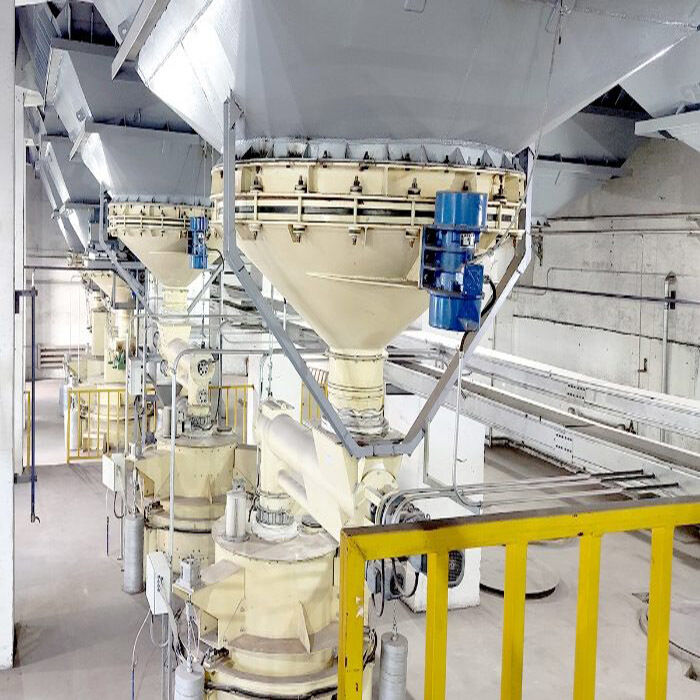
Feeding devices at the silo outlets include:

  • Storage hoppers with level sensors

  • Pneumatic vibrators to promote flow

  • Discharge gates and control valves

  • Local instrumentation for real‑time monitoring

Mixing unit – the heart of the blending process:

Feature Function
Discharge door Quickly empties mixed batch
Mixing drum Homogenises all raw materials
Water injection system Enhances moisture uniformity
Turbine impeller Provides powerful stirring action
Lubrication pump Supplies oil to the gearbox

Conveying system:

  • Belt conveyor: heavy‑duty rubber belt with vulcanised splices for long life.

  • Drive assembly: motor, high‑speed coupling, geared reducer (with backstop), and low‑speed coupling – all in an open design for easy servicing.

Bucket elevator – chosen for its high capacity, tall lift, smooth running, and extended service life. It consists of five main sections: top housing, bottom boot, intermediate casing, drive unit, and inspection access.

8. Quality Assurance & After‑Sales Support

Every system undergoes factory acceptance testing (FAT) prior to shipment. We also provide on‑site supervision during installation, commissioning, and operator training. Our global service network ensures rapid response to any technical queries, with spare parts readily available for all critical components.

FAQ

Q: What is JEFFER’s core business?

A: JEFFER Engineering and Technology Co., Ltd is a specialised engineering firm offering integrated solutions – from project design and technical consulting to EPC contracting and operational management.

Q: Do you provide custom design services?

A: Absolutely. We develop complete engineering drawings tailored to your production targets, site constraints, and budget.

Q: How do I obtain a quotation?

A: For equipment supply, please share your desired output specifications and material characteristics – we will propose an optimised solution with cost breakdown. For engineering services, outline your project scope, and we will furnish a detailed work plan and timeline.